|
|
|
After burning of Shaolin
The previous page mentioned the fleeing of the five ancestors after Sholin temple ws burned. Some other monks were said to have settled in Haichuang temple. They in turn transmitted their skills to other people such as Luk Ah Choy. Luk Ah Choy in turn taught Wong Tai, father of Wong Kei Ying. Kei Ying in turn taught his son Wong Fei Hung (1847-1924). Wong Fei Hung taught numerous students including Lam Sai Wing (1860-1943). At the Haichuang temple, the monk Kwok Yan supposedly taught Tid Kiu Sam (real name Leung Kwan) (1813-1886) two forms - 'tiger-crane' (fuhok seung ying kuen) and 'subdue the tiger' (gung ji fuk fu kuen). Tid later formulated a set of breathing exercises for developing internal power, Iron Wire kungfu (Tit Sin Kuen). These three sets later became part of the syllabus for hunggar - a style of kungfu based on Hongjia (Fujian) and Fojia (Guangdong) styles. Hunggar is well-known for its tiger claw, powerful movements and low stances. Note that Tid had several disciples and one of them taught kungfu to Wong Fei Hung. Tid Kiu Sam and Wong Kei Ying's abilities earned them the reputation as two of the Ten Tigers of Canton (Kwongtung sap fu).
|
|
|
Other Southern styles
During this time, other Southern styles began to flourish. Chowgar style was founded by Chow Loong (1893-1924) who combined Hunggar with the fast footwork of choygar and the kicks of Northern Shaolin. Chow Loong also earned a reputation in the South. |
CHOYLEEFUT
Cailifo (Choy Lee Fut) style was founded in 1836 by Grandmaster Chan Heung (1806-1875), who learned from Chan Yuen Wu, LeeYau Shan and Choy Fook. The style is well known for its fast footwork, speed and power. Lohan Qigong is also taught. Chan Heung taught several students, including Cheung Yin who started the Hung Sing division. The present day keeper of the style is Chen Yongfa, descendant of Chan Heung. Tam Sam was a student of Cailifo kungfu. After a misunderstanding, he left and traveled to many places, constantly refining his skills while earning quite a reputation. Eventually, he settled down and started the Buk Sing division of Cailifo. Tam was impressed with Ku Yu Cheung when the two of them met. As a result of their friendship, they exchanged knowledge. Gu yuzhang (Ku Yu Cheung) (1894-1962) started teaching Northern Shaolin style kungfu in the Southern part of China during the 1930s. This style is well known for its kicks (training in tamtui). Gu was also well-known for his iron palm which was reportedly powerful enough to break a coconut. He could also perform great feats of internal strength due to qigong training.
|
|
|
|
Other styles
Other styles that developed during the 18th Century include Wuzuquan (Five Ancestors) and Yongchun (wingchun). Five Ancestors style refer to White Crane, Monkey, Taizu, Lohan and Damo. Wuzuquan was developed in the Fujian Province and reflects the well-known Fujian Shaolin torso principles of swallowing, spitting, floating and sinking. Meanwhile, wingchun style emphasizes the use of 'soft' force and is well-known for it sticky hands (chisau) training method. During the late 1980s, the government of China realized the need to recover its cultural heritage and compiled a set of movements that was called 'wushu'. Wushu is well-known for its artistic and acrobatic themes as reflected in some of its routines' kicks, jumps and aerial movements. |
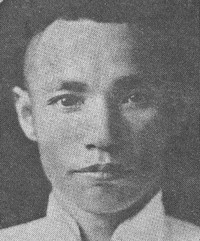
Grandmaster Tam Sam (right)
Grandmaster Tam was well-known for his fast and powerful charpchui (knuckles rotate with a screw-like motion).
|
|
|
|
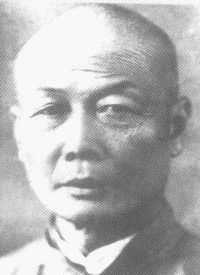
Grandmaster Ku Yu Cheung (left)
Grandmaster Ku was well-known for his iron palm and 'hard qigong' abilities. Unfortunately, he passed away at a relatively young age. |
|
|
|
|
Grandmaster Sek Koh Sum (Shaolin yizhimei lineage)
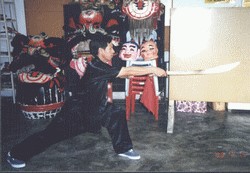
Grandmaster Sek was reported to be one of the last martial monk of the Shaolin Temple... He left behind a legacy of kungfu and healing traditions (e.g., treating joint injury) in many places including Malaysia and Singapore. Some of his students still teach his arts - such as yijinjing, and Shaolin yizhimei kungfu in these countries. |
|
|
|
|
|
|
Reference
Robert Z. Shaolin Kung Fu History. http://www.shaolin.com.au/history.htm
Salvatore Canzonieri. Contradicting a Legend Part 1 & 2. In Wushu KUNGFU Oct / Nov 1996.
Southern Shaolin Kung Fu: Sek KohSum. (1992, June). Combat, 18(2).
Ma Yau Ching. (1984). Terms of Kung Fu. Hong Kong: Wanli shu dian.
http://www.hungkuen.net http://www.atlantamartialarts.com/styles/shaolin.htm http://panda.bg.univ.gda.pl/~kwachu/YMAA/MA_HISTORY.html http://www.martialartsca.com/hungar.html http://www.southshaolin.com/5fists.htm
Peter Lim's Taijiquan Resource Page. http://web.singnet.com.sg/~limttk/
http://www.fact-index.com/t/ti/tiger_kung_fu.html http://home.earthlink.net/~liangfok/reference/kung_fu/
http://www.buksing.com
http://www.clfma.com
http://www.tigerkungfu.com
|
|
|
|